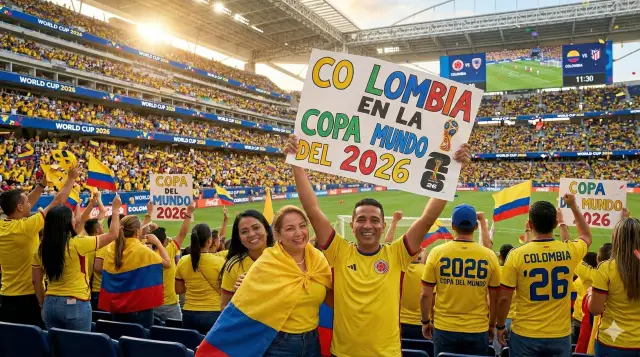
Expectations for the Colombian National Team at the 2026 World Cup
Colombia's participation in the 2026 World Cup represents much more than just sporting achievement; it's the culmination of a renewal process that has ignited the hopes of millions of fans. After missing the 2022 tournament, the national team has focused its efforts on solidifying a distinct playing style under the guidance of head coach Néstor Lorenzo. The aim is to surpass previous historical performances, leveraging a squad that blends the experience of established stars with the energy of young talents shining in the most competitive leagues in Europe and the Americas.
The road to this tournament has been demanding, but it has served to strengthen the team's mentality. The Colombian National Team seeks not only to qualify, but to arrive with a competitive rhythm that will allow them to be a key player in a competition that, for the first time, will feature 48 teams. This increase in the number of participants changes the dynamics of the tournament, but for the Colombian squad, the objective remains the same: to advance to the final stages and demonstrate that Colombian football belongs among the global elite. Within the calendar of must-see sporting events in Colombia , the national team's matches always hold a place of honor due to the social unity they foster.
How Colombia is preparing for the World Cup in the United States, Mexico, and Canada
The logistical and sporting preparation for a tournament of this magnitude requires meticulous planning. The Colombian Football Federation has prioritized friendly matches against rivals from various confederations to adapt the team to different playing styles. Furthermore, the coaching staff has closely monitored the players at their respective clubs, ensuring they reach peak physical and mental performance by the summer of 2026.
A key aspect of this preparation is adapting to the climatic and geographical conditions of the host countries. With matches being played in three different countries, travel will be long and temperature variations considerable. Colombia has evaluated potential base camps in cities that facilitate mobility and offer high-performance facilities. The aim is to minimize player fatigue so they can perform at their best in every match of the group stage and the knockout rounds.
The path of the South American Qualifiers towards 2026
The CONMEBOL qualifiers are recognized as the toughest in the world due to the parity of the teams and the extreme playing conditions, from the altitude of La Paz to the heat of Barranquilla. To secure their place in the 2026 World Cup in Colombia, the national team has had to maintain an enviable level of consistency both at home and away. The qualifying process has served to test new tactical variations and for younger players to adapt to the pressure of wearing the national team jersey.
It is vital for fans to closely follow the 2026 World Cup qualifying schedule to understand how the team's character has been forged. Every point earned in difficult venues has been a step towards the ultimate goal. Defensive solidity and goal-scoring prowess have been the pillars upon which this qualification has been built, allowing the country to dream once again of a feat similar to that of Brazil 2014.
Venues and stadiums where Colombia could play in the 2026 World Cup
The 2026 World Cup will be historic due to its scale. With 16 host cities spread across three nations, the logistics for Colombian fans will be an exciting challenge. A large number of compatriots living abroad, especially in the United States, are expected to support the team at each stadium, turning the stands into a sea of yellow. The venues have been selected for their state-of-the-art infrastructure and their capacity to host world-class events.
Depending on the official draw, Colombia could play its matches in cities with a strong Latin American presence. This not only guarantees a local atmosphere for the players but also facilitates cultural integration during the tournament. Fans are advised to consult the complete 2026 World Cup schedule, including dates, venues, and times, to plan their trips in advance and secure accommodation in the most strategic locations.
Host cities in the United States, Mexico, and Canada
The cities chosen for this grand event offer a unique cultural and climatic diversity. In the United States, metropolises like Miami, New York/New Jersey, Los Angeles, and Houston stand out. In Mexico, the historic Azteca Stadium in Mexico City, along with Guadalajara and Monterrey, will contribute the traditional passion of Latin American football. Meanwhile, Canada will feature Toronto and Vancouver as its main venues. Each of these cities is preparing to welcome millions of tourists, and Colombia hopes to make its mark on each one.
For Colombians, cities like Miami and Orlando are often natural meeting points due to air connectivity and the large Colombian community established there. The possibility of playing at Hard Rock Stadium or MetLife Stadium generates special excitement, as these are venues where the national team has performed well in the past during continental tournaments and friendly matches.
Key players of the Colombian National Team for the 2026 process
Colombia's success at the 2026 World Cup will largely depend on the form of its key players. Luis Díaz is emerging as the star and a game-changer on the wings, capable of turning a match around with his speed and technique. Alongside him, rising stars in midfield and defense have provided a much-needed solidity. This blend of youth and experience is the hallmark of this process.
The goalkeeping and defensive positions also feature players who have gained experience in European leagues. The captains' leadership will be crucial in guiding the debutants through the pressure of a World Cup. The coaching staff has emphasized the importance of the team over individual talent, fostering healthy competition for every starting position, which raises the overall level of the squad.
The leadership of Luis Díaz and the experience of the role models
Luis Díaz not only contributes goals and assists, but his presence on the field intimidates opponents and motivates his teammates. However, he is not alone. Players with experience in previous World Cups provide the necessary calm in tense moments. This balance is what allows Colombia to control the tempo of matches, alternating between explosive attacks and organized defense. The tactical evolution of these players reflects the growth of Colombian football.
History of Colombia in the World Cups and its evolution
To understand Colombia's importance in the 2026 World Cup, it's necessary to look back and remember the path they've traveled. Since their first participation in Chile in 1962, where they achieved the historic 4-4 draw against the Soviet Union (including the only Olympic goal in World Cup history, scored by Marcos Coll), Colombian football has gone through various stages of growth and learning.
The 1990s marked a golden era with three consecutive qualifications (1990, 1994, 1998), led by figures like Carlos 'El Pibe' Valderrama and Freddy Rincón. Although the results were mixed, the foundations were laid for a footballing identity based on passing and possession. After a long absence, the return in 2014 under José Pékerman resulted in their best performance ever, reaching the quarterfinals and seeing James Rodríguez win the tournament's Golden Boot.
From Chile 1962 to consolidation in Brazil 2014
Each World Cup has taught a lesson. In Italy 1990, the country thrilled to Rincón's goal against Germany; in Brazil 2014, the world was captivated by the talent of a generation that played without inhibition. These experiences have shaped the mentality of today's Colombian footballer, who no longer settles for simply participating, but competes on equal footing with the world's powerhouses. History is a driving force that propels the newly called-up players to write their own glorious chapters in 2026.
Cultural and social impact of football on the Colombian calendar
In Colombia, football is not just a sport; it's a social phenomenon that brings the country to a standstill. When the national team plays, cities turn yellow, businesses adjust their hours, and families gather around the screen. This impact is reflected in the Colombian sports calendar for 2026 , where match days become unofficial holidays celebrated with passion in every corner of the country.
The celebrations typically include food gatherings featuring traditional dishes, music, and a sense of national unity that few other activities manage to evoke. Football acts as a social balm and a source of pride that transcends political or regional differences. Therefore, qualifying for a World Cup is experienced as a collective triumph that boosts the morale of the entire nation.
How Colombians are experiencing World Cup fever
From major cities like Bogotá, Medellín, and Cali to the most remote villages, World Cup fever is evident in flags displayed in windows and jerseys worn early in the morning. Schools and businesses often provide spaces for watching the matches, recognizing that the emotional well-being of citizens is linked to the team's performance. It's a time when hope is renewed and national identity is strengthened through the cry of a goal.
The format of the 2026 World Cup and what it means for Colombia
The format change for the 2026 World Cup is one of the most debated topics. Expanding from 32 to 48 teams will substantially alter the tournament structure. There will be more groups and an additional knockout round (round of 32). For Colombia, this means a different margin for error in the initial phase, but a longer and more physically demanding path to the final.
This new format allows more nations to participate, enriching the cultural diversity of the event. However, for teams with high aspirations like Colombia, it requires superior physical preparation to withstand the additional matches. Squad depth will be key to rotating players without sacrificing quality on the field.
The increase to 48 selections and the new opportunities
With more teams competing, the 2026 World Cup will offer unprecedented matchups. Colombia could face teams from continents they don't usually compete against, requiring a more comprehensive tactical analysis from the coaching staff. Furthermore, the increased number of CONMEBOL qualifying spots has provided greater peace of mind, but also the responsibility to demonstrate why South America remains the cradle of the best football on the planet.
Tips for Colombian fans planning to travel to the 2026 World Cup
If you're planning to support Colombia at the 2026 World Cup, prior planning is essential. Traveling to North America requires considering visa procedures, transportation costs, and accommodation. Since distances between venues can be thousands of kilometers, using domestic flights or high-speed trains will be necessary. It's important to be aware of non-working days in Colombia and how they differ from official holidays to coordinate your vacation and ensure you don't miss any of the tournament.
Furthermore, it is recommended to purchase tickets only through official FIFA channels to avoid scams. Demand will be extremely high, so keeping an eye on the sales phases is crucial. It is also helpful to learn about the local customs of the host cities in Mexico and Canada to have an enriching and respectful travel experience.
Finally, don't forget to always carry the colors of your flag with you and experience this tournament with the joy that characterizes the Colombian people. The 2026 World Cup promises to be an unprecedented celebration, and the presence of the Colombian fans will undoubtedly be one of the most vibrant and passionate displays in the North American stadiums. Get ready for an unforgettable month where football and culture come together at the biggest sporting event of the decade.
To stay informed about key dates and not miss any important events, you can regularly check what's happening in Colombia each month of the year , ensuring your calendar is always up-to-date with the best of our culture and sports.