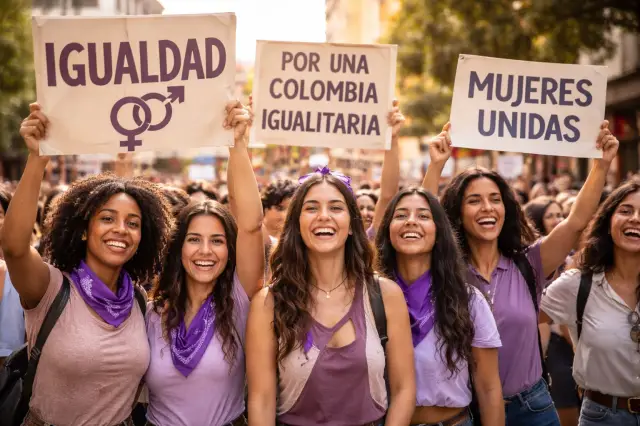
Every March 8th in Colombia , as in the rest of the world, International Women's Day is commemorated, a date that goes beyond tributes and flowers. It is a day of reflection, of recognizing the historical struggles of women for equal rights, and of commitment to the challenges that still persist in Colombian society.
The origin of International Women's Day
The history of this commemoration has its roots in the women's labor movements of the late 19th and early 20th centuries, especially in the United States and Europe. In Colombia, the date became firmly established in the second half of the 20th century, when various feminist and social organizations began to advocate for women's role in political, professional, and family life.
March 8th symbolizes resistance, the struggle for decent working conditions, access to education, equal pay, and participation in all spheres of power.
How is March 8th celebrated in Colombia?
In Colombia, major cities organize marches, forums, and cultural activities to honor the role of women. Universities, public and private institutions also hold events that promote gender equality and highlight female leadership.
Some of the most common manifestations include:
Feminist marches and sit-ins in Bogotá, Medellín, Cali and Barranquilla.
Forums on reproductive rights, political participation and labor gaps.
Awards for outstanding women in science, art, sports and entrepreneurship.
Institutional campaigns against gender violence.
These activities seek not only to celebrate, but also to raise awareness about the challenges that persist in issues such as workplace harassment, domestic violence, and economic inequality.
March 8th as a day of reflection and action
More than a celebration, March 8th is a day for reflection on progress and remaining challenges. In Colombia, the figures continue to show significant gaps:
According to DANE, women earn on average 12% less than men.
Female participation in management positions barely exceeds 30% .
Gender-based violence continues to be a serious social problem.
These realities give the date a profound meaning, inviting all of society to take concrete actions to build a more just and equal Colombia.
How to support gender equality in Colombia
Supporting equality is not solely the responsibility of institutions, but a collective commitment. Some everyday actions can have a significant impact:
Educating for equality from home, fostering respect and co-responsibility.
Support female entrepreneurship and consume products from women entrepreneurs.
Report gender violence and support victims.
Promote female leadership in work, educational and community spaces.
To make the work of women visible in all sectors.
You can also participate in citizen initiatives, workshops or campaigns that promote equality, such as those promoted by organizations like UN Women, Sisma Mujer or the Women's Secretariat in Bogotá.
Gender equality as a driver of development
Equality between men and women is not only a matter of social justice, but also an essential condition for a country's development . Various studies show that more equitable economies and societies are also more sustainable, innovative, and peaceful.
In Colombia, promoting female participation in science, politics, education, and entrepreneurship means harnessing the talent and creativity of more than half the population.
The role of education and the media in transformation
The cultural shift towards an egalitarian society begins in education and the media . Schools, universities, and digital platforms have a responsibility to promote positive messages about equality, diversity, and respect.
Colombian women who have made history
Colombia has been the birthplace of great women who have transformed history with their talent, commitment, and leadership. Some of them are:
Policarpa Salavarrieta , heroine of independence.
Débora Arango , a pioneer in modern Colombian art.
María Cano , symbol of the workers' and feminist movement.
Mariana Pajón , a sporting role model and an example of discipline.
Francia Márquez , vice president and defender of environmental and ethnic rights.
Their stories show that gender equality is not a utopia, but a path that Colombia continues to build step by step.
What can we expect from International Women's Day 2026 in Colombia?
For International Women's Day 2026 , national events are expected to focus on digital inclusion, political leadership, and women's economic empowerment. Furthermore, a growing number of companies and public entities are implementing gender equality policies , demonstrating that equality also drives productivity.
A commitment that must last all year
Celebrating March 8th shouldn't be limited to just one day. True transformation happens when actions are sustained over time and become part of our everyday culture.
Every gesture, every conversation, and every shared opportunity are steps towards a more just, free, and equitable society for everyone.