Peru is one of the most culturally diverse countries in Latin America. Throughout its territory, from the coast to the Amazon, ancestral rituals and customs survive and are still practiced today, forming part of the daily lives of many communities. These traditions not only have historical value but also reinforce cultural identity and a spiritual connection with nature.
Unlike other cultural expressions that have adapted over time, many Peruvian rituals retain their original essence. They are practices passed down from generation to generation that continue to hold profound social, religious, and symbolic significance.
The payment to the earth or offering to Pachamama
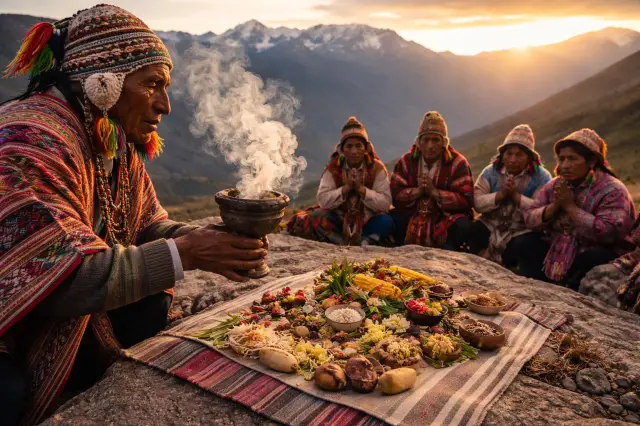
One of the best-known and most practiced ancestral rituals in Peru is the payment to the earth, also called the offering to Pachamama. This ceremony has pre-Hispanic roots and remains prevalent mainly in Andean communities.
The ritual consists of offering various symbolic elements to the earth, such as coca leaves, food, chicha (a fermented beverage), seeds, flowers, and other objects that represent gratitude and respect. Pachamama is considered a living being that provides food, protection, and balance.
This ritual is performed especially in August, a month considered sacred to the earth, although it can also be practiced before planting, traveling, or starting important projects. In many rural homes, making an offering to the earth is an integral part of family and community life.
Image suggestion: Photograph of a payment to Mother Earth in the Peruvian Andes. Alternative text: Ancestral ritual of payment to Mother Earth in Peru.
The ritual use of the coca leaf
The coca leaf has a spiritual, medicinal, and social significance that dates back to ancient times. For the Andean peoples, coca is a sacred plant used in ceremonies, rituals, and daily practices.
Chewing coca leaves, known as chacchado, is an ancestral custom that helps combat cold, fatigue, and altitude sickness. Coca is also used in rituals of divination, gratitude, and spiritual protection.
Despite modern prejudices, the coca leaf remains a deeply respected cultural symbol in many regions of Peru.
Reading coca leaves
Within ancestral Andean practices, coca leaf reading is a traditional form of spiritual guidance. Andean sages interpret the shape, position, and fall of the leaves to answer questions, predict events, or seek emotional balance.
This custom remains alive in rural communities and in ceremonial contexts, especially during important festivities or momentous decisions.
Rituals of gratitude to water
Water has always been considered a sacred element by the indigenous cultures of Peru. In various Andean and Amazonian communities, rituals of gratitude are performed for rivers, lakes, and springs.
These ceremonies aim to ensure abundant water, fertile land, and the well-being of the community. In some cases, they are combined with current religious festivities, creating a unique cultural syncretism.
Inti Raymi and the Andean worldview
Inti Raymi, although now a cultural celebration, originated in an ancient Inca ritual dedicated to the Sun. This ceremony marked the beginning of a new agricultural cycle and reaffirmed the relationship between humankind and the celestial bodies.
In many communities, the Andean worldview remains present through respect for the Sun, the Moon, and the mountains, known as apus, considered protective spirits.
Amazonian healing rituals
In the Peruvian Amazon, ancestral rituals are closely linked to nature and traditional medicine. Shamans or healers perform healing ceremonies using medicinal plants, chants, and ritual baths.
These practices seek to restore the physical and spiritual balance of the person, and are still consulted today by local residents and visitors.
The harvest festival and agricultural rituals
Agricultural activities in Peru are accompanied by rituals that celebrate planting and harvesting. These ancestral customs express gratitude to the land and strengthen community work.
In many rural areas, these celebrations include music, dances, traditional food, and symbolic offerings.
Spiritual protection rituals
In various regions of the country, rituals persist that are intended to protect people and homes from negative energies. These include spiritual cleansings and the use of amulets and symbolic objects.
These practices are part of popular wisdom and continue to be valued as tools for emotional well-being.
Cultural importance of preserving these customs
Peru's ancestral rituals and customs represent an invaluable cultural heritage. Preserving them not only means keeping ancient traditions alive, but also strengthening national identity and respect for cultural diversity.
In an increasingly globalized world, these practices remind us of the harmonious relationship between human beings and nature, knowledge that remains relevant today.