
Non-working days in Colombia are one of the most frequent searches when people need to know if they should work, study, or if they can plan a trip or vacation. Although many believe that every non-working day is a holiday, in reality , not all non-working days are official holidays , and this difference has important legal, labor, and educational implications.
This article provides a clear, up-to-date, and easy-to-understand explanation of what non-working days are in Colombia, how they differ from official holidays, what the law says, and how they apply in the public, private, and educational sectors. It will also serve as a practical guide for planning your year based on the Colombian calendar.

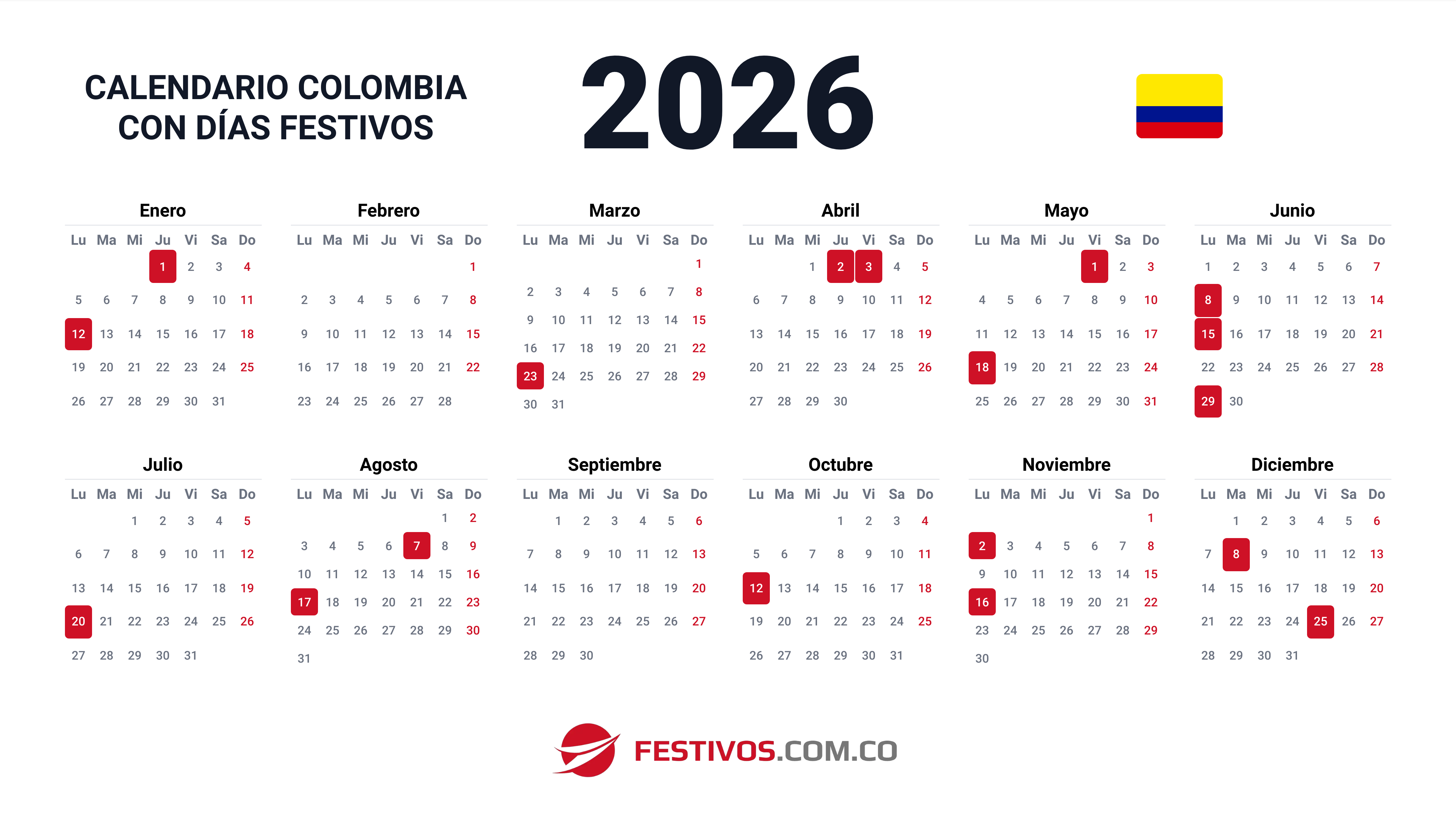

What are considered non-working days in Colombia?
In Colombia, a non-working day is one on which there is no general obligation to work , but it is not always officially recognized as a national holiday . In other words, a non-working day can be declared by the government, a public entity, a mayor's office, or even a private company, without automatically implying overtime pay or mandatory rest for all workers in the country.
This concept often causes confusion because in everyday language it is used as a synonym for festive, when in legal terms they are not the same .
On the website CalendarioDeColombia.com, these types of topics are constantly being developed to help citizens correctly interpret the national calendar and avoid errors in work, school, or travel planning. You can find more related articles at
What are the official holidays in Colombia?
Official holidays in Colombia are days established by law as mandatory days off . They are regulated primarily by the Substantive Labor Code and by the well-known Emiliani Law , which moved several holidays to Mondays with the aim of promoting tourism and extended rest periods.
When a day is an official holiday:
It applies to the entire national territory.
It requires paid rest for the worker.
If you work, it generates a Sunday or holiday surcharge .
It applies to both the public and private sectors, except for legal exceptions.
Each year, the complete list of official holidays is published and updated on specialized portals such as CalendarioDeColombia.com, where long weekends and their impact on daily life are also explained.
Key difference between non-working days and official holidays
The main difference lies in the legal backing and its effects on employment . To understand this better, take a look at this comparison:
| Aspect | Non-working days | Official holidays |
|---|---|---|
| National legal support | Not always | Yeah |
| Applies to the entire country | Not necessarily | Yeah |
| Mandatory rest | It depends on the case | Yeah |
| Surcharge if working | Generally not | Yeah |
| Mandatory payment | It depends on the employer. | Yeah |
This distinction is fundamental for workers, employers, students, and parents, especially when special days are announced for civic events or government decisions.
Examples of non-working days in Colombia
There are several types of non-working days that are not official holidays :
Civic holidays
These holidays are decreed by the national government, regional governments, or municipalities to commemorate special events. Common examples include civic holidays for elections, international visits, or local celebrations.
In these cases:
They generally apply only to the public sector.
The private sector decides whether to accept it or not.
They do not generate a mandatory surcharge if you work.
Non-working days for public employees
Some government entities establish internal non-working days, such as compensatory days or institutional days. These do not apply to private companies or nationwide.
Non-working days in educational institutions
Schools and universities may declare non-working days for professional development days, teacher training, or calendar adjustments. This does not mean it is a national holiday.
What happens to the private sector on non-working days?
In the private sector , non-working days are not mandatory , unless there is a contractual agreement, collective agreement or internal decision of the company.
This means that:
The employer can decide whether to grant the day off.
You can request compensation on another day.
He is not required to pay surcharges if the employee works that day.
Therefore, before assuming that a non-working day implies rest, it is always advisable to check the company's internal policies.
Non-working days and public employees
For public employees , non-working days decreed by the Government are usually mandatory, provided they are explicitly directed to the public sector.
However, these days:
They are not considered official holidays.
They do not generate special surcharges.
They are governed by specific and temporary decrees.
This type of information is especially consulted during election periods or during relevant national events.
Non-working days during election period
During elections in Colombia, election day is usually declared a civic or non-working day to facilitate the right to vote.
In this context:
Public employees usually have the day off.
In the private sector, time should be given to vote, but not necessarily the entire day.
It is not considered an official holiday.
This is one of the clearest cases where the difference between a non-working day and a holiday is evident.
Impact of non-working days on schools and universities
In the educational field, non-working days are frequent and are due to:
Pedagogical workshops.
School calendar adjustments.
Institutional activities.
These days:
They do not affect the general work schedule.
They can make up the time with classes on other dates.
They have no legal effect outside the education sector.
For parents and students, it is key to consult the official academic calendar of each institution and not assume that a non-school day is a national holiday.
How to know if a day is an official holiday or just a non-working day
To avoid confusion, follow these practical recommendations:
Check if the day appears on the official list of national holidays.
Check official decrees if a civic holiday is announced.
Confirm with your employer or educational institution.
This verification is especially important for issues related to payment, surcharges, travel, and personal organization.
Why is it important to know this difference?
Knowing the difference between non-working days and official holidays in Colombia allows you to:
Avoid workplace misunderstandings.
Plan holidays and breaks realistically.
Understand your rights and responsibilities as a worker.
Organize family and academic activities.
Furthermore, it improves civic education and helps to correctly interpret government decisions related to the national calendar.
Relationship between non-working days, holidays and tourism
Although non-working days do not always create long weekends, they do influence:
Vehicular traffic.
Operation of public entities.
Commercial dynamics in some regions.
That's why many tourism and annual planning articles on CalendarioDeColombia.com combine both concepts to offer a more complete view of the Colombian calendar.
Common non-working days that cause confusion
Some of the most frequently consulted are:
National civic days.
Days after the election.
Institutional days of the public sector.
Compensatory days announced by mayors.
In all these cases, it is essential to check whether or not it is recognized as an official holiday.
Difference between a commemorative day and a non-working day
A commemorative day recalls a historical or cultural event, but does not imply rest . A non-working day may imply partial or sectoral rest, but is not always commemorative .
This nuance also often causes confusion and deserves attention when consulting calendars.
Non-working days and time off compensation
In some cases, non-working days must be compensated:
With additional hours.
Work on another day.
With work schedule adjustments.
This depends on the sector, the type of contract, and internal policies, so there is no single rule.
Importance of consulting reliable calendars
In a country with as many holidays as Colombia, having a reliable source is key. Specialized websites like CalendarioDeColombia.com offer:
Updated calendars.
Clear legal explanations.
Additional articles on holidays, long weekends and special dates.
This helps avoid common mistakes and make informed decisions throughout the year.